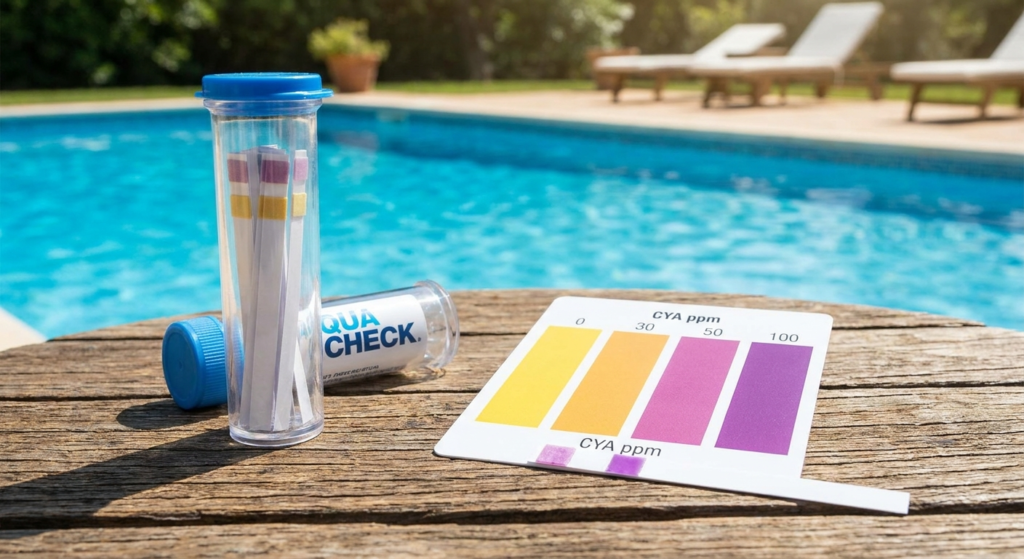

Cyanuric acid (CYA), often called pool stabilizer or conditioner, is a mild acid that protects chlorine from the sun’s ultraviolet rays.
Without it, chlorine breaks down within hours, leaving your pool vulnerable to bacteria, algae, and contaminants.
Maintaining CYA levels within the recommended range of 30–50 ppm (parts per million) for chlorine pools, or 60–80 ppm for saltwater pools, is critical for effective sanitation.
When levels drop too low, you must take action to restore them.
This guide explains why CYA matters, what causes low levels, and the two proven methods to raise cyanuric acid safely.
Why Cyanuric Acid Matters
CYA forms a weak bond with free chlorine molecules in the water.
This bond acts as a sunscreen, shielding chlorine from UV degradation while still allowing it to break free and sanitize when needed.
The bond is dynamic: CYA releases chlorine gradually, extending its lifespan three to five times longer than unstabilized chlorine.
Without adequate CYA, you would need to add chlorine constantly to keep the pool clean, which becomes expensive and inefficient.
Causes of Low Cyanuric Acid
Several factors can reduce your pool’s CYA concentration.
The most common cause is using only unstabilized chlorine—such as liquid chlorine (sodium hypochlorite) or calcium hypochlorite—which contains no added CYA. Over time, the existing CYA gets diluted.
Dilution also happens from heavy rain, splash-out, backwashing the filter, or partially draining and refilling the pool.
Even evaporating water does not remove CYA, but any fresh water added to top off the pool will lower the concentration.
Thus, regular testing is essential to catch a drop early.
Problems from Insufficient CYA
When CYA dips below 30 ppm, several issues arise.
First, chlorine demand increases sharply because sunlight destroys the sanitizer before it can work.
You may add chlorine and still find levels falling rapidly.
Second, the remaining chlorine becomes less effective at killing bacteria and algae, leading to cloudy water and potential algae blooms.
Third, without stabilized chlorine, free chlorine can convert into chloramines—compounds that create the strong “chlorine smell” and irritate eyes and skin.
Finally, the entire water chemistry becomes harder to balance, affecting pH and total alkalinity.
In short, low CYA undermines all your other pool care efforts.
How to Raise Cyanuric Acid
Raising CYA is straightforward, but you must first test your water and ensure pH and total alkalinity are within ideal ranges.
Use test strips that include a CYA reading or take a sample to a pool store.
Once you know your current level and your pool’s volume, you can choose one of two methods.
Method 1: Using Stabilized Chlorine
Stabilized chlorine—available as dichlor or trichlor in granular, tablet, or liquid form—already contains cyanuric acid.
This method works best when you need a modest CYA increase of less than 10 ppm, because the amount of chlorine added must also remain safe (1–3 ppm).
To use it, calculate the required dose based on your pool’s volume and current CYA.
Mix granules in a bucket of pool water and pour along the perimeter, or place tablets in a floating dispenser or skimmer.
Run the pump for at least six hours, then retest. Repeat if needed.
Be aware that trichlor tablets also lower pH slightly, so monitor that afterward.
Method 2: Using Pure Cyanuric Acid
For larger increases, add pure cyanuric acid (granular stabilizer).
This method allows you to adjust CYA without changing chlorine levels.
First, determine how much to add: roughly 13 ounces of pure CYA raises a 10,000-gallon pool by 10 ppm. Always follow the product label.
Wear protective gear—gloves and eyewear—because the acid can damage pool surfaces if handled improperly.
Fill a five-gallon bucket with warm pool water, then slowly add the measured CYA (never the reverse).
Stir briefly, then pour the mixture directly into the skimmer while the pump runs.
For a slower dissolution, place the granules in a fine-mesh sock and hang it in front of a return jet. Allow the pump to run for 24–48 hours.
CYA dissolves slowly; do not retest for at least 48 hours.
Many pool owners find the step-by-step guidance in how to raise cyanuric acid level in pool helpful for accurate dosing and timing.
Maintaining Proper CYA Levels
Once you reach the target range, test your CYA monthly during swim season.
Avoid overusing stabilized chlorine tablets, as they can push CYA too high over time.
If levels exceed 80 ppm for chlorine pools or 100 ppm for saltwater pools, you must lower them by partially draining and refilling—there is no chemical shortcut.
Regular monitoring and careful product selection keep your pool water balanced, clear, and safe for swimming.