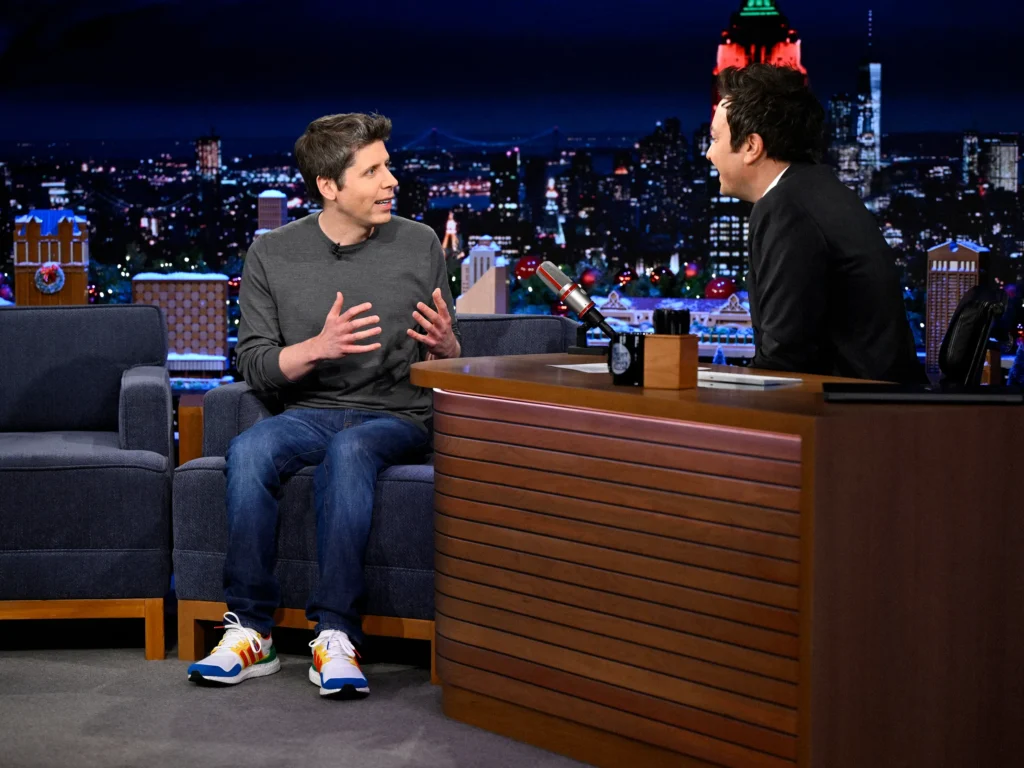

Sam Altman is one of the best-known names in modern artificial intelligence. He is an entrepreneur, investor, and technology executive. Most people know him through OpenAI, the company behind ChatGPT. Yet his career started long before ChatGPT became popular. He first built a technology startup and later led Y Combinator. These experiences placed him near many fast-growing technology companies. He then helped launch OpenAI in 2015. Today, his work covers artificial intelligence, startups, energy, and other emerging technologies. His career also includes major challenges and public debates. This guide looks at his background, education, business journey, leadership, investments, and influence. It also separates established facts from common online assumptions.
Sam Altman Biography Table
| Detail | Information |
| Full Name | Samuel Harris Altman |
| Common Name | Sam Altman |
| Profession | Entrepreneur, investor, technology executive |
| Known For | OpenAI and Y Combinator |
| OpenAI Role | Co-founder and CEO |
| Earlier Startup | Loopt |
| Former Major Role | President of Y Combinator |
| Y Combinator Presidency | 2014–2019 |
| OpenAI Founded | 2015 |
| Main Industry | Artificial intelligence and technology |
| Education | Attended Stanford University |
| Major Interests | AI, startups, energy, technology |
| Notable AI Product Connected to OpenAI | ChatGPT |
| Current Significance | Leading figure in commercial AI development |
OpenAI describes Sam Altman as its co-founder and CEO. It also states that he served as president of Y Combinator from 2014 until 2019. OpenAI was launched as a nonprofit research organization in 2015.
Who Is Sam Altman?
Sam Altman is closely linked with the rapid growth of generative AI. However, describing him only as the leader of ChatGPT misses much of his story. His career includes startup building, investing, company leadership, and technology development. Before OpenAI became famous worldwide, he spent years working inside Silicon Valley’s startup community.
His experience at Y Combinator was especially important. The accelerator helps young companies grow and connect with investors. Altman served as its president between 2014 and 2019. Later, his public profile grew greatly through OpenAI. The organization works on advanced artificial intelligence systems and products. In 2026, OpenAI still identifies him as its co-founder and CEO. This long journey helps explain why his name now appears in discussions about AI, entrepreneurship, computing, and the future of technology.
Early Life and Interest in Technology
Sam Altman’s interest in computers developed when he was young. Technology gave him a way to explore ideas and understand how digital systems worked. That interest eventually became the foundation of his professional career. Rather than following only a traditional corporate path, he entered the startup world.
His early experiences are useful for young entrepreneurs to study. Successful technology careers rarely begin with a global company. They often start with curiosity and small experiments. Learning how products work can eventually lead to much bigger opportunities. Altman’s later work followed that pattern. He moved from software and startup development into investing and business leadership. Eventually, he became closely involved with advanced artificial intelligence. His journey shows how early technical curiosity can grow into a much wider business career.
Education and the Stanford Years
Sam Altman attended Stanford University and studied computer science. However, he did not complete a traditional degree path there. Instead, he left Stanford while working on his startup ambitions. This choice later became an often-mentioned part of his entrepreneurial story.
Leaving college is not a guaranteed path toward business success. Thousands of successful founders also complete their education. Altman’s experience should therefore be understood as one individual path rather than a formula. What mattered more was how he continued learning through building products and companies. Startup work forced him to understand customers, technology, hiring, fundraising, and growth. Those practical lessons became useful during later stages of his career. His story highlights a simple point: formal education can be valuable, but learning also continues through experience, mistakes, and real-world problem solving.
The Loopt Startup Journey
One of Sam Altman’s first major business projects was Loopt. The startup focused on mobile location and social technology. It emerged during a period when smartphones and location-based services were becoming more important. Building the company gave Altman firsthand experience with startup life.
Running an early company involves much more than creating an interesting idea. Founders must build products, find users, raise money, and manage teams. They must also adjust when markets change. These lessons later became useful when Altman began helping other founders. Loopt never reached the global scale associated with his later work. Still, it represented an important stage in his development as an entrepreneur. Early ventures do not need to become household names to teach valuable lessons. In Altman’s case, startup experience helped prepare him for leadership roles involving much larger organizations.
Sam Altman and Y Combinator
Y Combinator became a major chapter in Altman’s career. The startup accelerator supports founders while their companies are still young. Altman eventually became its president in 2014 and remained in that position until 2019.
This role exposed him to a wide range of founders, products, and business models. Instead of concentrating on one startup, he could study the challenges faced by many companies. That perspective helped broaden his experience as an investor and technology leader. Startup accelerators also teach founders to focus on products that solve genuine problems. This idea remains useful beyond Silicon Valley. A product needs more than hype. People must find it valuable. Altman’s Y Combinator years therefore form an important bridge between his early startup career and his later work with artificial intelligence.
How Sam Altman Became Involved With OpenAI
OpenAI was publicly introduced in December 2015 as a nonprofit artificial intelligence research organization. Sam Altman and Elon Musk were named as its co-chairs. The founding group also included several well-known AI researchers and technology leaders.
The organization’s stated goal focused on developing advanced AI for broad human benefit. Over time, its structure and operations changed as AI development required increasingly large amounts of computing power and investment. OpenAI created a for-profit subsidiary in 2019. In October 2025, it announced another structural change. The nonprofit became the OpenAI Foundation, while its for-profit arm became OpenAI Group PBC. The Foundation continues to control the Group. These changes are important because OpenAI today is very different in scale from the research organization introduced in 2015.
Sam Altman and the Growth of ChatGPT
For millions of people, Sam Altman became familiar because of ChatGPT. The product helped bring generative artificial intelligence into everyday life. People began using AI for writing, coding, learning, research, brainstorming, and other tasks. This shift made OpenAI far more visible outside the technology industry.
It is important, however, not to describe ChatGPT as the work of one person. Large AI products require researchers, engineers, product teams, safety specialists, designers, and many other professionals. Altman’s role is primarily connected with leadership and company direction. OpenAI itself developed from a large research and engineering organization. Its earlier language-model work included systems such as GPT-2, which OpenAI publicly discussed in 2019. ChatGPT’s success therefore reflects years of research and teamwork rather than a single invention by one executive.
The 2023 OpenAI Leadership Crisis
One of the most dramatic moments in Sam Altman’s career occurred in November 2023. OpenAI’s board announced that he would leave his CEO position. The original announcement said the board had lost confidence in his leadership after a review of his communications with directors.
The situation changed quickly, and Altman ultimately returned. In March 2024, OpenAI announced the completion of an external review conducted by WilmerHale. According to OpenAI, the review involved dozens of interviews and more than 30,000 documents. The board then expressed confidence in the continuing leadership of Altman and Greg Brockman. Altman also rejoined the board. The episode became an important case study in startup governance. It showed that even highly successful technology organizations can face difficult questions about leadership, boards, communication, and corporate structure.
OpenAI’s Current Structure and Altman’s Role
OpenAI’s organizational structure has continued to evolve. As of the structure announced in October 2025, the nonprofit is called the OpenAI Foundation. The commercial organization is OpenAI Group PBC, a public benefit corporation. The Foundation controls the Group through special governance rights.
Sam Altman remains CEO and also sits on the OpenAI Foundation board. This structure matters when discussing his position. Calling OpenAI a normal private technology company can leave out important details about its governance. The organization combines commercial activity with a nonprofit-controlled structure and a stated mission concerning advanced artificial intelligence. Understanding this background gives readers a clearer picture of Altman’s responsibilities. His role involves not just products. It also includes fundraising, organizational strategy, research priorities, partnerships, and the difficult task of scaling powerful AI systems.
Sam Altman’s Approach to Artificial Intelligence
Sam Altman often discusses artificial intelligence as a technology that could produce major social and economic changes. OpenAI’s public writing has emphasized potential uses in education, productivity, scientific work, and creative tasks. At the same time, OpenAI leaders have written about risks connected with highly capable AI systems.
In 2026, Altman and OpenAI chief scientist Jakub Pachocki compared the possible impact of AI with earlier transformative technologies. Their published plan emphasized wider access and potential benefits from increasingly capable systems. These are OpenAI’s stated views, rather than guaranteed predictions. The future effects of advanced AI remain uncertain. Researchers, businesses, governments, and communities continue debating safety, employment, copyright, competition, energy use, and regulation. Readers should therefore distinguish ambitious forecasts about AI from outcomes that have already been demonstrated.
Investments Beyond Artificial Intelligence
Sam Altman’s business interests extend beyond OpenAI. His investment activity has included companies working on energy and other emerging technologies. One prominent example is Helion Energy, a company developing nuclear fusion technology. Reuters reported in 2025 that Altman was among Helion’s existing investors.
Fusion is attractive because researchers hope it may eventually provide large amounts of low-carbon energy. Yet commercial fusion remains a difficult technical challenge. Helion has continued raising significant capital. In June 2026, Reuters reported a new funding round that valued the company at $15.5 billion. Altman’s interest in energy also connects with a wider technology challenge. Powerful computing systems require substantial electricity and infrastructure. For technology leaders, future energy supply can therefore be closely linked with the growth of AI and large data centers.
Sam Altman and World Network
Another project connected with Sam Altman is World, previously widely known as Worldcoin. The project seeks to provide a way of proving that an online user is a real human. Its system has used an iris-scanning device known as the Orb to create a World ID.
The idea has received attention because AI can make it harder to distinguish humans from automated accounts online. However, biometric identity systems also create privacy and regulatory questions. Reuters reported that the project faced scrutiny in several countries over data and privacy concerns. This makes World an interesting example of a broader issue connected with artificial intelligence. As AI-generated content becomes more capable, proving human identity online may become more valuable. At the same time, any system involving sensitive biometric information needs strong privacy protections and careful oversight.
Leadership Lessons From Sam Altman’s Career
Sam Altman’s career offers several practical lessons without requiring readers to copy every decision he made. One is the importance of staying close to major technological changes. He moved from mobile technology into startup investing and later advanced AI. Another lesson is that networks matter. Working with founders, engineers, investors, and researchers can expose leaders to ideas they would never discover alone.
His career also demonstrates that growth creates new problems. A small research organization can operate differently from a global technology company. Governance, financing, safety, and public responsibility become harder as an organization expands. The 2023 OpenAI crisis made this especially clear. Strong products alone cannot remove leadership challenges. Successful organizations also need clear roles and reliable decision-making systems. For entrepreneurs, that may be one of the most useful lessons from Altman’s story.
Why Sam Altman Is an Important Technology Figure
Sam Altman matters because his career sits at the meeting point of several major technology trends. These include artificial intelligence, startup funding, digital identity, advanced computing, and future energy systems. His leadership at OpenAI gives him an especially visible position in the AI industry.
Still, technological progress is never created by one individual. OpenAI’s products depend on large teams of researchers, engineers, designers, policy specialists, and other employees. The wider AI field also includes universities, open-source communities, competing companies, chip makers, data-center operators, and independent researchers. Viewing Altman within this larger ecosystem provides a more accurate picture. He is an influential executive and entrepreneur, but the development of modern artificial intelligence is a broad, collaborative process involving many organizations and thousands of people.
What Comes Next?
The next stage of Sam Altman’s career will likely remain closely connected with increasingly capable AI systems. OpenAI has publicly described its mission as ensuring that artificial general intelligence benefits humanity. The organization also says it expects continued progress toward much more capable systems.
Predictions about AGI or superintelligence should not be treated as established timelines. AI research can move quickly, but technical limits and unexpected discoveries can change plans. Regulation, energy availability, hardware, safety research, and public acceptance may also shape development. That uncertainty makes Altman’s future role interesting to watch. His work is tied not only to better software, but also to questions about how advanced technology should be developed, funded, governed, and shared.
Conclusion
Sam Altman has traveled from startup founder to one of the world’s most visible AI executives. His early work with Loopt gave him startup experience. His years at Y Combinator connected him with a wider entrepreneurial community. OpenAI then placed him at the center of the generative AI boom.
His story also includes setbacks, leadership disputes, organizational changes, and ambitious technology projects. That makes his career more useful to study than a simple success story. It shows how technology leadership combines ideas, teams, capital, governance, and long-term planning. As artificial intelligence continues developing, Sam Altman will remain a closely watched figure. Readers interested in AI should follow the technology itself as well as the researchers, companies, rules, and communities shaping its future.
FAQs
Who is Sam Altman?
Sam Altman is an American technology entrepreneur, investor, and executive. He is best known as the co-founder and CEO of OpenAI. Earlier in his career, he helped build Loopt and later became president of Y Combinator. OpenAI currently identifies him as its co-founder and CEO. His public profile grew greatly as generative artificial intelligence became widely used. Today, discussions about his career often cover AI, startup investment, energy, digital identity, and technology leadership.
Is Sam Altman the founder of OpenAI?
Sam Altman is one of OpenAI’s co-founders, but he did not create the organization alone. OpenAI was formed by a group of technology leaders and artificial intelligence researchers. Its 2015 announcement named Altman and Elon Musk as co-chairs and identified several other founding members. Therefore, describing Altman as the sole founder would be inaccurate. OpenAI’s development has always involved a large team of researchers, engineers, executives, investors, and partners.
Did Sam Altman create ChatGPT himself?
No. ChatGPT was not created by one person. Sam Altman leads OpenAI, but products like ChatGPT require large research and engineering teams. Modern language models are built through years of research, computing infrastructure, testing, product development, and safety work. OpenAI was already publishing work on GPT language models years before ChatGPT became widely known. For example, it publicly described GPT-2 in 2019. Altman’s role is mainly associated with executive leadership and company strategy.
Is Sam Altman still the CEO of OpenAI?
Yes. As of the latest information checked for this article in September 2026, OpenAI identifies Sam Altman as its CEO. He is also listed as a member of the OpenAI Foundation board. His position briefly became uncertain during the November 2023 leadership crisis. However, he returned to the company, and OpenAI announced in March 2024 that he would also rejoin its board.
What companies and technologies is Sam Altman connected with?
Sam Altman is most strongly associated with OpenAI, Loopt, and Y Combinator. His broader technology interests also include energy and digital identity. He has invested in Helion Energy, a nuclear fusion company. He is also associated with World, a digital identity and cryptocurrency-related project that uses World ID. These activities show that his interests extend beyond generative artificial intelligence into technologies that may support a more AI-driven economy.
Why is Sam Altman famous?
Sam Altman is famous mainly because of his leadership at OpenAI and his connection with the growth of generative artificial intelligence. He was already well known in startup circles because of Y Combinator. ChatGPT later introduced OpenAI to a much larger global audience. His public role now covers discussions about AI development, safety, investment, computing infrastructure, and future technology. This combination has made him one of the most recognizable executives associated with today’s artificial intelligence industry.